Showing posts with label Taiwan. Show all posts

Friday, June 6, 2025

Suzuki et al. on Criminal Penalties for IP Infringement in Asia

            For the most part, criminal law does not play a large role in the enforcement of patent rights, although TRIPS article 61 does require that member states make available criminal penalties for “wilful trademark counterfeiting or copyright piracy on a commercial scale”; some free trade agreements extend the obligation to criminalize IP infringement a bit further (e.g., to anti-circumvention measures); and in some places, including the U.S., criminal penalties sometimes are imposed for trade secret misappropriation.  Some countries, moreover, make all or most types of IP infringement at least potentially subject to criminal penalties, although the criminal prosecution of patent infringement isn’t very common (though it does happen from time to time).

Anyway, I’m finishing up work on my book Remedies in Intellectual Property Law, and the last chapter deals with, among other things, criminal enforcement, so I though I would call readers’ attention to a paper that addresses the criminal enforcement of IP rights in the leading Asian jurisdictions.  The authors are Masabumi Suzuki, Su-Hua Lee, Byungil Kim, Xiuqin Lin, Prashant Reddy, Heng Gee Lim, Jyh-An Lee, and Kung-Chung Liu, and the paper is  titled Civil Follow Criminal or Criminal Follow Civil Procedure as Models to Deal with IP Infringement: Asian vis-à-vis Western Approaches, in Kreation Innovation Märkte - Creation Innovation Markets:  Festschrift Reto M. Hilty 663 (Florent Thouvenin, Alexander Peukert, Thomas Jaeger & Christophe Geiger eds., Springer 2024).  Here is a link to the ssrn version, and here is the abstract:

Art. 61 of the TRIPS Agreement of the World Trade Organization (WTO) requires members to provide criminal punishment at least for willful trademark counterfeiting and copyright piracy on a commercial scale. Sweeping criminalization of IP infringement can be observed in the West typified by Germany and many major Asian jurisdictions. However, in practice, there has been relatively rare criminal prosecution of IP infringement in the West, whereas criminal prosecution of IP infringement, excluding patent infringement, is not uncommon or even common in the seven selected Asian jurisdictions. Why is there such a difference? and what effects does it have on the overall development of IP laws in those Asian jurisdictions? These two questions among others are what this article strives to answer. It will first survey the Asian IP landscape, in the order of the introduction of IP laws into the civil law jurisdictions (Japan, Taiwan, Korea, and China), and into common law jurisdictions (India, Malaysia, and Hong Kong) respectively (2). It will then examine German experiences (3), followed by comparative study and policy analysis (4), and end with some suggestions (5).

Highly recommended!


Thursday, March 7, 2024

Cotter and Shen on Destruction and Proportionality

My article with Professor Chung-Lun Shen, Destruction, Proportionality, and Sustainability: A Law-and-Economics Analysis, 32 Texas Intellectual Property Law Journal 111 (2024), has now been published.  It is available on Westlaw and SSRN, and should be available soon on TIPLJ’s website.  Here is the abstract:

This Paper undertakes a law-and-economics analysis of the remedy of destruction (and, subsidiarily, the related remedies of recall and removal) of products that infringe intellectual property (IP) rights. We begin with a brief survey of international, regional, and domestic law and practice, observing that (1) courts generally are believed to be more likely to order the destruction of copyright- and trademark-infringing goods than of patent-infringing goods, and (2) the frequency with which courts order the destruction of patent-infringing goods varies from one country to another. Our observations lead us to present two principal theses.


The first is that a comparative reluctance to order the destruction of patent-infringing goods, as opposed to copyright- or trademark-infringing goods, would be consistent with economic considerations. From an economic standpoint, destruction can be viewed both as a complement to injunctive relief and as a substitute (albeit an imperfect one) for ongoing monitoring of an infringer’s compliance with the terms of an injunction. The social benefits arising from substituting destruction for monitoring, however, are likely to be lower—on average, and perhaps subject to regional variation—for patent-infringing goods than for products that infringe other IP rights. In addition, although observers have long noted that the private and social costs of destruction provide a rationale for withholding that remedy when it would cause disproportionate harm to the defendant or third parties, these costs may be unusually high in patent cases—particularly that subset of cases in which the risk of patent holdup is substantial. In view of these factors, the social costs of ordering the destruction of patent-infringing goods are likely to outweigh the social benefits in a comparatively broader swath of cases.

In addition, I may as well note a paper I just came across in the preceding volume of TIPLJ, Deepa Sundararaman & Cleve B. Tyler, A Detailed Study of Court Decisions on Admissibility of Intellectual Property Damages Experts, 32 Tex. Intell. Prop. L.J. 45 (2023).  Here is a link to the paper, and here is the abstract:

Damages experts’ opinions in intellectual property litigation are routinely challenged for failing to reach standards set forth in the Supreme Court’s 1993 Daubert decision. Our study is the first of its kind, in performing a systematic and in-depth review of court decisions, including an analysis of the substantive reasons for challenge. We studied more than 400 Daubert orders covering nearly 1,300 decisions over a six-year period from 2015 through 2020.


Patent cases make up a significant majority of our dataset. Overall, we find an exclusion rate of 24%. While plaintiff experts are challenged more frequently than defendant experts, their exclusion rates are not significantly different. However, the type of analysis challenged appears to matter—in particular, lost profits analyses are excluded at lower rates than other types of analyses, and experts described as offering legal opinions are excluded at higher rates. Exclusion rates vary by district, with the Northern District of California (NDCA) having higher exclusion rates and the Eastern District of Texas (EDTX) having lower exclusion rates than the rest of the country. We study the impact of the Supreme Court’s Heartland decision on exclusion rates, which has reduced a plaintiff’s ability to engage in “venue shopping.” Overall, rates of exclusion in EDTX and Delaware declined following the decision, with a moderate increase in exclusion rates in NDCA.


Finally, we find substantial disparities in exclusion rates among judges. Among the top ten judges ranked by number of decisions, five have relatively “low” exclusion rates of less than 15% and four have relatively “high” exclusion rates greater than 30%. Variations such as these, along with differences by jurisdiction, raise questions about courts’ consistency in application of the Daubert standard—questions that are left for future researchers and policymakers to address.

Thursday, June 1, 2023

Cotter and Shen on Destruction, Proportionality, and Sustainability

Chung-lun Shen and I have posted a paper on ssrn titled Destruction, Proportionality, and Sustainability: A Law-and-Economics Analysis.  We will be presenting it at the 2023 ATRIP Congress at the University of Tokyo in July.  Here is a link to the paper, and here is the abstract:

 This paper undertakes a law-and-economics analysis of the remedy of destruction (and, subsidiarily, the related remedies of recall and removal) of products that infringe intellectual property (IP) rights. We begin with a brief survey of international, regional, and domestic law and practice, observing that (1) courts generally are believed to be more likely to order the destruction of copyright- and trademark-infringing than of patent-infringing goods, and (2) the frequency with which courts order the destruction of patent-infringing goods varies from one country to another. Our observations lead us to present two principal theses.


The first is that a comparative reluctance to order the destruction of patent-, as opposed to copyright- or trademark-infringing goods, would be consistent with economic considerations. From an economic standpoint, destruction can be viewed as both a complement to injunctive relief, and as a substitute (albeit an imperfect one) for the ongoing monitoring of an infringer's compliance with the terms of an injunction. The social benefits arising from substituting destruction for monitoring, however, are likely to be lower—on average, and perhaps subject to regional variation—for patent-infringing goods than for products that infringe other IP rights. In addition, although observers have long noted that the private and social costs of destruction provide a rationale for withholding that remedy when it would cause disproportionate harm to the defendant or third parties, these costs may be unusually high in patent cases—particularly that subset of cases in which the risk of patent holdup is substantial. In view of these factors, the social costs of ordering the destruction of patent-infringing goods are likely to outweigh the social benefits in a comparatively broader swath of cases.


Our second thesis can be best understood if we first pose a question: given that courts generally have authority to consider proportionality when deciding whether to order the destruction of infringing goods, why are legislatures and courts (other than in the United States, and to some degree other common-law countries) so unwilling to consider proportionality when deciding whether to grant injunctive relief? One obvious reason is that a stay or denial of injunctive relief imposes greater costs on the judiciary, insofar as a court that stays or denies an injunction must be prepared to set the terms of an interim or ongoing royalty; in addition, a stay or denial may introduce additional error costs, to the extent courts impose over- or undercompensatory royalties. We propose, nonetheless, that the factors that sometimes persuade courts to deny requests for destruction should render them at least marginally more receptive than they currently are to staying or denying injunctions, particularly when there is a substantial risk of holdup. In addition, environmental costs may be reduced if, in appropriate cases, courts were more willing to stay injunctions pending the sell-off or design-around of infringing products, rather than requiring their destruction or long-term storage.

Comments welcome.  Thanks also for a shout-out from Professor Larry Solum, on his Legal Theory blog earlier this week!

Monday, June 22, 2020

Sung on Liability for Wrongly Issued Preliminary Injunctions

Although this article came out in 2015, I just recently learned of it.  The author is Professor Huang-Chih Sung of National Chengchi University in Taipei, where I taught last December, and the article is titled Patentee's Liability for Wrongful Preliminary Injunction-Case Studies in China and Taiwan, 34 Biotechnology Law Report 133-151 (2015).  The article provides a good overview of the standards for determining whether a patentee is liable to an accused infringer, if the former obtains a preliminary injunction but (for example) the patent is later invalidated or found not to infringe.  The title mentions China and Taiwan, but the article also briefly discusses the relevant provisions under TRIPS and has a fairly extensive discussion of U.S. law as well.  The bottom line, at least as of 2015, is that it is more difficult for the wrongly-excluded defendant to obtain compensation under Taiwanese law than under either U.S. or Chinese law, and the author advocates some reforms.  Highly recommended.

For recent discussion on this blog of compensation for wrongly-issued injunctions in Australia, France, and the E.U., see here and here.  

Friday, December 13, 2019

My week in Taiwan

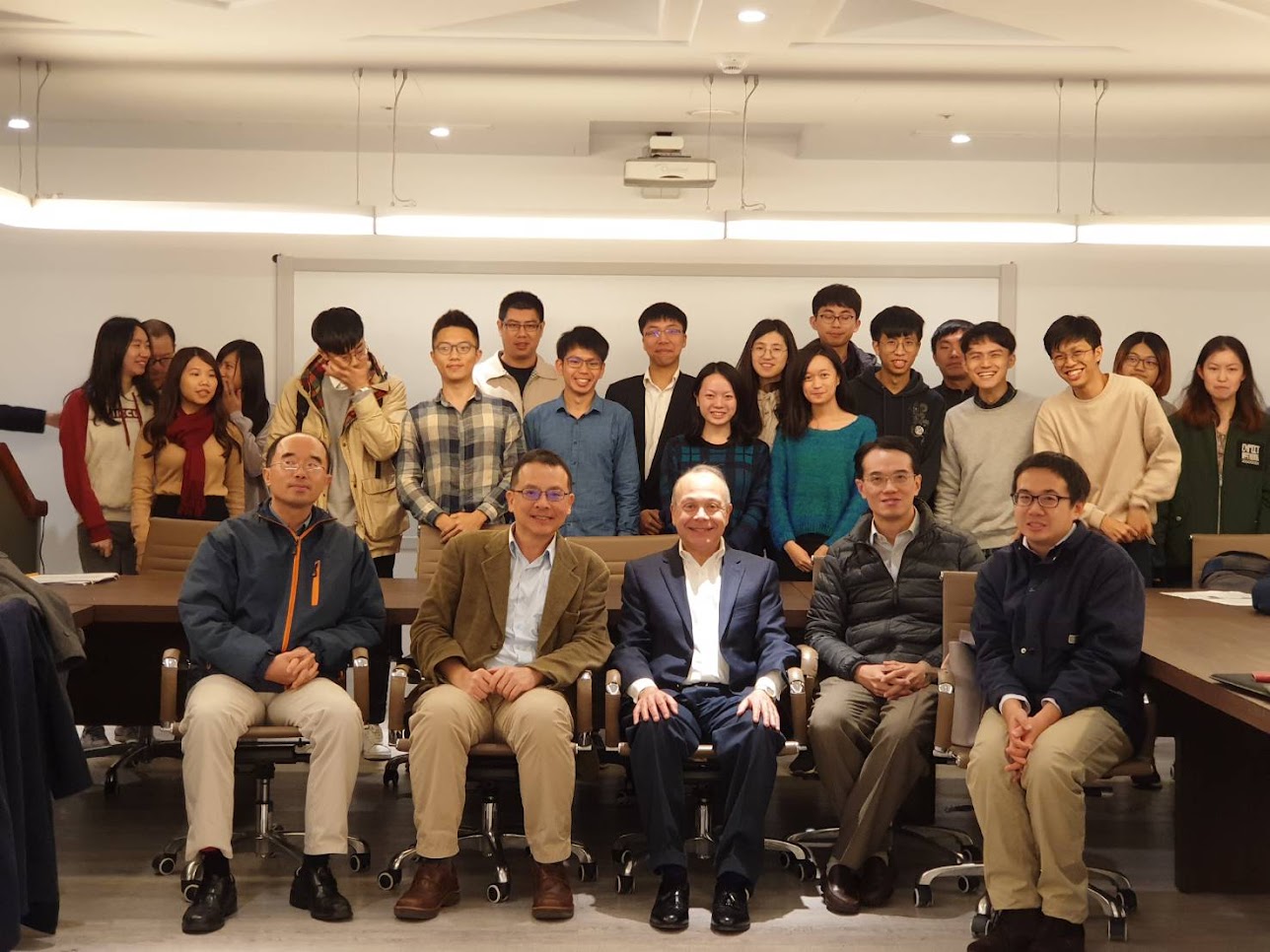
As I mentioned at the end of November, I had a series of speaking engagements lined up in Taiwan during the first week of December.  I would like to thank Professor Chung-Lun Shen for inviting me, and for his great hospitality in hosting me throughout the week.  I greatly enjoyed  spending time with Professor Shen and his family; meeting and interacting with students, judges, and other academics; and seeing some of the terrific sights around Taipei.  I learned a lot about the Taiwanese law of patent damages, and hope to incorporate some of what I learned into future writing projects.

My schedule for the week was busy.  On Monday, December 2, I gave a talk titled Extraterritorial Damages in Patent Law to the judges of Taiwan's Intellectual Property Court.  I plan to develop this into an article or a portion of an article on extraterritoriality in the near future.  In case readers are interested, here are my slides.  

Tuesday through Thursday, I guest-lectured in Professor Shen's class at National Chengchi University (NCCU) on, respectively, (1) Introduction to Comparative Patent Remedies, (2) Introduction to Standard Essential Patents and FRAND Royalties, and (3) The Comparative Law of Patentable Subject Matter.  

Finally, on Friday, December 6, I gave a presentation titled Damages for Noneconomic Harm in Intellectual Property Law at a Patent Damages Symposium organized by NCCU and National Taiwan University.  Again, in case readers are interested, here are the slides from this presentation.  I am working on a paper on this subject too, and comments on this or on the extraterritorial damages slides would be welcome.

Friday, November 29, 2019

Blogging break

I will take a blogging break next week, while I visit National Chengchi University (NCCU) in Taipei, Taiwan.  On Monday, I will be giving a presentation titled Extraterritorial Damages in Patent Law to the judges of Taiwan's Intellectual Property Court.  Tuesday through Thursday, I will be guest-lecturing in Professor Chung-Lun Shen's class on, respectively, (1) Introduction to Comparative Patent Remedies, (2) Introduction to Standard Essential Patents and FRAND Royalties, and (3) The Comparative Law of Patentable Subject Matter.  Friday, I will give a presentation titled Damages for Noneconomic Harm in Intellectual Property Law at a Patent Damages Symposium organized by NCCU and National Taiwan University.  I will return to blogging the following week.

Friday, December 21, 2018

Papers from PatDam 2; Punitive Damages in Korea; Qualcomm v. Apple

1.  As I mentioned on Wednesday, at least some of the papers presented at the February 2017 University of Texas Patent Damages Conference Part 2 have now been published.  At present, there doesn't appear to be a page on either the Texas Intellectual Property Law Journal (TIPLJ)'s or The Review of Litigation (TROL)'s website dedicated to all of the papers from this conference, as there was for PatDam 1.  (See here--though it now appears that some of the links on that page are dead.  The students running the site need to fix this, and to post all of the papers from PatDam2 which, after all, took place nearly two years ago.)  But here are the ones I've been able to locate.  All of the papers below are available on Westlaw, and some are probably available, perhaps in earlier versions, on ssrn.

John M. Golden, Foreword:  Channeling Patent Damages, 26 TIPLJ v (2018). 
Jennifer L. Blouin & Melissa F. Wasserman, Tax Solutions to Patent Damages, 26 TIPLJ 1 (2018).
Anne Layne-Farrar, The Patent Damages Gap:  An Economist's Review of U.S. Statutory Patent Damages Apportionment Rules, 26 TIPLJ 31 (2018).
Hon. Arthur J. Gajarsa, William F. Lee & A. Douglas Melamed,  Breaking the Georgia-Pacific Habit:  A Practical Proposal to Bring Simplicity and Structure to Reasonable Royalty Damages Determinations, 26 TIPLJ 51 (2018).
Oskar Liivak, Beyond Circularity:  Licensing for Innovation, 26 TIPLJ 113 (2018). 

There is also a commentary on Blouin & Wasserman's paper by Susan C. Morse, titled Seeking Comparable Transactions in Patent and Tax, in The Review of Litigation--The Brief (which I think is that journal's online companion), available here.

2.  On the IAM Blog earlier this week, Bing Zhao published a post titled Korea Adopts Treble Damages in Bid to Curb "Technology Extortion."  According to the post, treble damages will be available for willful patent infringement and trade secret misappropriation.  Courts will consider various factors ("recognition of infringement by the infringer or potential loss on the part of a patent owner," etc.) as relevant to willfulness.  Korea thus joins Taiwan and, possibly this coming year, China, in authorizing awards of treble damages.

3.  As many readers are aware, courts in China and Germany recently entered injunctions against certain models of iPhones in patent litigation initiated by Qualcomm.  Florian Mueller has had a series of posts on the German litigation, and his post today goes into some detail on the nature of the injunction, the possibility of Qualcomm being liable for wrongful enforcement damages if the trial court judgment is reversed on appeal, etc.  For other coverage, see, e.g., this article in the Wall Street Journal.

*                    *                    *

I plan to take a blogging break through the end of the year, and to resume after January 1.  Best wishes to my readers for the holiday season!

Friday, December 7, 2018

From Around the Blogs Part 1: Damages in Canada, Spain, Taiwan, and the U.S.

1.  On the Sufficient Description blog, Norman Siebrasse has posted a four-part series (here, here, here, and here) on a recent decision of Canada's Court of Appeal, Apotex Inc. v. Eli Lilly & Co.  The decision holds, among other things, that (1) in assessing patent damages a court must consider whether an alleged noninfringing alternative (the existence of which would reduce the amount of damages) was objectively economically viable (thus rendering irrelevant Apotex's assertion that, but-for the infringement, it would have turned to an alternative that was unprofitable); (2) where, as here, use of the asserted noninfringing alternative would have infringed another of the plaintiff's patents, it would not have been an available alternative; and (3) compound interest is available as a "head of damages," but that there is no presumption in favor of its use.  Professor Siebrasse has some insightful observations about the first two of these holdings in particular.

2.  On the Kluwer Patent Blog, Miguel Montañá published a post titled Damages may be considered proven when the facts speak for themselves.  The post discusses a July 2018 decision of the Barcelona Court of Appeal holding that in some instances the "facts speak for themselves," that is, "the existence of damages if intrinsic to the nature of the infringement and does not require special proof."  If I understand correctly, however, the patent owner would still bear the burden of coming forward with evidence as to the amount of its injury, even if the fact of injury is presumed.  Apparently the facts of this particular case showed that the plaintiff was in negotiations with a customer when the defendant supplied that customer with an infringing product.

On a personal note, I will be speaking at one or two forums in Barcelona in late March 2019.  I'm looking forward to returning to one of my favorite cities.

3.  On the IAM Blog, Yulan Kuo published a post titled Taiwan Supreme Court Issues Decision on Unfair Enrichment in Patent Infringement Case.  According to the author, in Koninklijke Philips NV v. Gigastorage Corp. the court reversed the Taiwan IP Court's award of NT$1 billion for unjust enrichment and remanded for further consideration in light of various factors.  If I understand correctly, the court also wants the lower court to consider whether delay in enforcing one's rights might reduce the award, even if the statute of limitations has expired (compare with the U.S. Supreme Court's view in SCA Hygiene).  On a personal note here, I may be visiting Taiwan in the fall of 2019, so perhaps I will have an opportunity to discuss this case then. 

4.  On IP Watchdog, Mark Pedigo published a post titled Use of the Book of Wisdom in Reasonable Royalties, recapping the relevant Federal Circuit and lower court decisions permitting (or not) the use of information post-dating the date of the first infringement, for purposes of calculating reasonable royalties.  Mr. Pedigo concludes that "[u]se and acceptance of the book of wisdom can be relevant and useful, but it is not always allowed by the courts."

For some papers I have coauthored arguing that courts should be more open to the admissibility of such evidence, see here and here.

Monday, August 13, 2018

Big Numbers in Some Recent Patent Cases

The past few weeks have witnessed at least five multimillion dollar awards or settlements in patent or patent-related matters.  Without going into great depth about any of them, I thought it might be useful just to list them here, with some citations to further commentary.

1.   On July 27, a Delaware jury awarded IBM $82.5 million in a patent infringement case against Groupon.  The four patents in suit are all software/business method patents.  The jury also concluded that Groupon's infringement was willful, so there could be an enhancement yet to come.  For coverage, see articles on Bloomberg, CNET, IPWatchdog, and Law360.

2.  On August 1, a San Diego jury awarded Wilan $145 million in a suit against Apple, for the infringement of two patents related to wireless communications.  For coverage, see articles in Law360, the New York Times, and Reuters.

3.  On August 6, Arista agreed to pay Cisco $400 million to settle certain pending patent, copyright, and antitrust claims between the two firms.  For coverage, see articles in IPWatchdog, Law360,  Reuters, and the Wall Street Journal.

4.  On August 7, a jury in Chicago awarded three firms a total of $315 million in an antitrust action Scientific Games Corp., based on the latter's allegedly having engaged in sham litigation involving automatic card shufflers.  For coverage, see articles in Casino.org, Law360, and Reuters.

5.  On August 9, Qualcomm settled with the Government of Taiwan, in an antitrust dispute involving the licensing of Qualcomm patents in which the Taiwan Fair Trade Commission had previously leveled a $773 million fine.  The government will keep $93 million Qualcomm has already paid, and Qualcomm agreed to certain conditions in exchange, including investment in Taiwan.  For coverage, see articles in Bloomberg, IPWatchdog, and the Wall Street Journal.

Monday, October 2, 2017

Taiwan Appeals Court Awards Philips NT$1.1 Billion

Professor Chung-lun Shen of Taiwan's National Chengchi University has published a short article titled Taiwan Supreme Court to Clarify Distinction between Patent Damages and Unjust Enrichment:  Koninklijke Philips N.V. v. Gigastorage Corporation, in NAIP IP Observer #108, Sept. 28, 2017.  The article discusses a recent patent infringement case brought by Philips against Taiwanese manufacturer Gigastorage.  (Disclosure:  In 2007, I served as a proposed expert witness for the defense in a U.S. case brought by Philips against Gigastorage.)  According to the article, the trial court concluded that (1) there was no proof of infringement from January 1, 2000 to April 1, 2003; (2) there was proof of infringement from January 1, 2014 to February 14, 2015, but under the patent statute Philips could not recover (as it requested) an award of the defendant's profit for that period, because Gigastorage earned no profit from the sale of infringing products during that time; and (3) for the in-between period, Philips was barred from recovering patent damages due to the two-year statute of limitations, but under an unjust enrichment theory (for which the applicable statute of limitations is 15 years) it could recover the benefit Gigastorage incurred during that time.  The court calculated this benefit by (1) estimating Gigastorage's revenue from the sale of infringing products (NT$644 million), and then (2) based on the relative contributions of the patent in suit and other technology awarding NT$10.5 million (about US$347,000) altogether.  On appeal, the Court of Appeals awarded $NT1.1 billion (about US$33 million) for unjust enrichment, based on its view that the defendant derived a benefit equal to the royalty it would have paid had it not infringed.  The court calculated the royalty based on a price of $NT0.06 per infringing disk, concluding that apportionment is not relevant to the unjust enrichment remedy here, and that Philips offered Gigastorage an efficient package licensing deal.  The court also held that Philips's delay in filing suit did not bar the award, and the matter is now headed to Taiwan's Supreme Court.

The case is interesting for a number of reasons.  First, in some other countries including the U.K. and I believe Germany, a court will deny an award of infringer's profits under the patent statute if the infringer earned no profits, even though it may have incurred some benefit (for example, in the form of lower costs).  See my book p.203 for discussion of a relevant English case.  Apparently Taiwan follows the same rule.  Second, the Taiwanese court's practice of awarding monetary relief for an unjust enrichment claim, for which the applicable statute of limitations is longer than for a patent infringement claim, is consistent with practice in some other countries, including as I recall Germany and Japan.  Third, however, I'm not at all sure that it is sensible to award the entire benefit the infringer earned, where some of that benefit surely must depend on the use of other technologies; the trial court's "contribution" approach sounds more defensible than the Court of Appeals' rule.  (In the U.S., of course, the infringer of a design patent can be forced to disgorge the entire benefit derived from the relevant "article of manufacture," but as I've argued many times before that result makes little economic sense.  See, e.g., here.)  Fourth, the question of whether laches or equitable estoppel should be a defense to a claim that is brought within the relevant statute of limitations (here, for unjust enrichment) is reminiscent of the two recent cases in which U.S. Supreme Court has held that under U.S. law laches is not a defense to a claim for damages for patent or copyright infringement (see, e.g., here).

It will be interesting to see what happens before the Taiwan Supreme Court.   

Monday, December 2, 2013

Recent Federal Circuit Decision on Enhanced Damages and Attorneys' Fees

Dennis Crouch has already blogged about this opinion, but it's worth a mention here too.  Two weeks ago the court handed down a nonprecedential opinion in Lee v. Mike's Novelties, Inc., available here.  The patent claims a "metal tobacco pipe designed to resemble a Colt Six Shooter pistol."  Mike's also sold a pipe with rotatable turrets, and Lee filed suit for infringement.  A jury found for Lee and concluded that the infringement was willful, following which the district court awarded enhanced damages and attorneys' fees, the latter based both on the finding of willful infringement and on the basis of alleged "litigation misconduct, consisting of bad faith settlement offers, bad faith conduct during discovery, and threats to report Lee's counsel to state bar associations."  On appeal, the Federal Circuit affirmed the district court's claim construction and the findings of validity and infringement.  It reversed the award of enhanced damages, however, on the ground that the infringement was not objectively reckless, as required for a showing of willful infringement under the first prong of Seagate.  Specifically:
Although MWI raised a number of invalidity and noninfringement  theories, we focus on the objective reasonableness of its infringement defense. As the district court explained in its summary judgment order, there was a “genuine issue of material fact as to whether the turret remains stationary because the turret is heavier than the manifold” and therefore infringed the limitations of claims 1 and 11. JA 240. MWI argued at trial that Lee had not proven that the weight differential between the manifold and turret of the accused pipes was enough to keep the turret stationary, as the district court’s claim construction required. When asked at oral argument in this court why it was unreasonable for MWI to argue that the weight differential was insufficient to ensure stability,Lee’s counsel stated, “that would be a reasonable argument.” See Oral Argument at 16:45-16:48, available at http://www.cafc.uscourts.gov/oral-argumentrecordings/2013-1049/all. He offered no explanation why such an argument would be objectively unreasonable other than the fact that the jury reached the opposite conclusion.

To be sure, it was reasonable for the jury to conclude that the turret remained stationary relative to the manifold because of the weight differential, but that does not make the accused infringer’s defense objectively unreasonable. In this case, the evidence was close, and the critical factual determinations were left in the jury’s hands. The verdict was supported by substantial evidence, but there was countervailing evidence to support the defendant’s theory as well. The weight differential amounted to only 13 grams, which the jury might have considered insufficient. Moreover, Lee only weighed one of the two pipes and as the above discussion indicates, the jury could have reasonably concluded that MWI did not sell that pipe. Therefore, it was reasonable for MWI to contest the allegation of infringement and to argue that the plaintiff had not proven that the “weight differential actually maintains the turret [in a] stationary [position]” in either accused device. JA 606, ll. 4-5.
On the question of attorneys' fees, the  court remanded to determine whether the defendant's litigation misconduct standing alone was sufficient to make the case "exceptional . . . such that attorney's fees are warranted." (For my previous post on the two pending Supreme Court cases addressing attorneys' fees in patent cases, see here.)

As a matter of policy, I think the decision in Seagate was a step in the right direction, in that it makes it more difficult to justify awarding enhanced damages for infringement.  As an economic matter, enhanced damages make sense only to make up for a risk that the infringement would go undetected or that the defendant sought to make the enforcement of valid rights prohibitively expensive (see my book, pp. 72-73, 145-46).  The objective reasonableness of the defendant's defense is not a perfect proxy for either consideration, by any means, but at least the inquiry into reasonableness means that enhanced damages should be relatively rare--though for empirical evidence that they're not as rare as you might think, even after Seagate, see Christopher B. Seaman, Willful Patent Infringement and Enhanced Damages After In re Seagate : An Empirical Study, 97 Iowa L. Rev . 417, 420, 441 (2012) (reporting that findings of willful infringement had declined by about only 10% after Seagate).   

As for attorneys' fees, as I've said before I think a reasonable case can be made for awarding them as a matter of course to the prevailing party, as is the case in most countries (up to a point, anyway), but such a rule would certainly go against the grain in the U.S. (just as awarding enhanced damages would go against the grain in most other countries, though some inroads are being made on this front in Canada, Taiwan, and possibly China, as discussed here). Some of the current patent reform bills pending in Congress, however, would make fee awards somewhat more common, by permitting them in cases in which the defendant's position was not "substantially justified."  See my post on one of the pending bills, here.

Monday, November 18, 2013

Two articles on patent damages in China

A few weeks ago I posted a story titled "Draft Fourth Amendment of the Chinese Patent Act Would Authorize Treble Damages for Willful Infringement," available here, and mentioned a recent article.on the subject by Professor Zhang Guangliang, titled Thoughts on Effect of Patent Protection in China with Analysis of Some Important Issues Involved in Amendment to Chinese Patent Law, China Patents & Trademarks No. 3, 2013, pp. 100-03.  Professor Zhang also published an earlier paper in China Patents & Trademarks No. 1, 2012, pp.88-92, titled Punitive Damages Not Sound Strategy to Address Tough Issues of IP Protection in China.  Professor Zhang points out, among other things, that punitive or enhanced damages for patent infringement are not common worldwide (the U.S., Canada, Australia, and after a brief hiatus Taiwan are the only major patent systems I'm aware of that permit them); and that Chinese law already authorizes courts to enhance awards of reasonable royalties in cases involving intentional infringement (as I discuss in my book at p 358), and to take various factors into account in awarding statutory damages (see my book p.359).  Professor Zhang notes that "If it is impossible to find out the right owner's actual injury or the infringer's iillicit benefits, there is no basis for calculation of punitive damages.  Unfortunately, this is true in most IP infringement cases in China."  He argues that, rather than awarding punitive damages, it would make more sense if  litigants were more careful in trying to quantify actual damages or profits, and courts more receptive to granting evidence preservation measures and not imposing an excessively high burden of proof.  His analysis makes sense to me.

Another article in that same issue of China Patents & Trademarks (No. 1, 2012, pp.47-51) is by Xue Libo, Former Counsel to the Patent and Trademark Law Office CCPIT, and is titled Reflections on Damages for Patent Infringement.  The article discusses China Environmental Project Co., Ltd. v. Fujikasui Engineering Co., Ltd., Huayang Electric Power Co., Ltd. (Wuhan Jingyuan v. Japanese Fuji), a case I discuss in my book at pp.349-50, for its significance as a Chinese patent infringement decision in which the court declined to award a permanent injunction and instead ordered payment of an ongoing royalty.  The article by Mr. Xue focuses on the damages award.  The patentee Wuhan had been hired to consult Huayang and Fujikasui on a project, and later filed suit against them for patent infringement after they implemented Wuhan's proposed technical solution.  (Fujikasui made the infringing system and Huayang installed it.)  The patent application had been filed before the consultation arrangement, but if I'm reading Mr. Xue's analysis correctly Wuhan didn't inform its clients.  Mr. Xue argues that the court should take this fact into account in setting damages.)  Anyway, the trial court awarded Fujikasui's profits based on its total contract price, since Fujikasui did not provide information that would have allowed the court to deduce appropriate costs; and an ongoing royalty payable by Huayang.  On appeal, the court affirmed as to the amounts, but concluded that the two parties were jointly liable for the damages.  Mr. Xue argues that the finding the parties were jointly liable for damages was incorrect.  He also suspects there is some duplication in the damages award, since Fuijkasui was ordered to pay to Wuhan the price Huayang paid Fujikasui for the use of the technology, and then Huayang was ordered to pay royalties to Wuhan as well.  In addition, he is critical of the fact that the court did not apportion Fujikasui's profits, "since the contractual price (even if the hardware factors are deducted) includes . . . the technological R&D, design test Fujikasui Engineering Co., Ltd.  made to turn the technology into one of commercial value, costs paid for technical services and training for Huayang, and thus the value added to the contract . . . ."  A similar problem arose in the Chint utility model infringement case I discuss in my book at p.357, resulting there in an award of RMB 330 million (the largest to date) due in part to a failure to apportion.  Overall, a good read, though I would counsel against the author's advocacy, toward the end of the paper, of the 25% rule which was rejected in the U.S. Uniloc decision in early 2011.   


Thursday, August 15, 2013

Shen on Reasonable Royalties Under Taiwanese and Chinese Law

I discuss patent damages in China and Taiwan in my book at pages 353-60, 370-72.  For a more detailed discussion of the law of reasonable royalties under Taiwanese and Chinese law, check out the current issue of the Chicago-Kent Journal of Intellectual Property, which has an article by Professor Chung-Lun Shen titled Reasonable Royalties and the Calculation of Patent Damages:  Reflections and Recommendations for a Fair and Adequate Calculating Basis of Reasonable Royalties in Terms of Harmonization of China-Taiwan Regional Patent Laws. Professor Shen notes, among other things, that until the amendments which went into effect on January 1, 2013, the Taiwanese statute did not explicitly provide for awards of reasonable royalties (although courts sometimes awarded them nonetheless).  If I get around to publishing a second edition of my book someday, as I hope I will, I will definitely cite this paper. 

Tuesday, August 6, 2013

After a Six-Month Hiatus, Enhanced Damages for Patent Infringement in Taiwan Are Back

This had escaped my attention until today, when I noticed this article by Daisy Wang of Lee & Li.  As I mentioned in my book pp. 370-72, until recently Taiwan had been one of the few countries other than the United States to authorize awards of up to treble damages in cases of intentional infringement; but the Taiwanese legislature deleted this provision from the Taiwan Patent Act when it amended the act in 2011.  The amendment only became effective on January 1, 2013.  So I was surprised to read that the provision on enhanced damages is now back in, after only a six-month hiatus.  (Altogether a small package of amendments to the Taiwan Patent Act were approved in May and went into effect on June 11, as reported in Ms. Wang's article, by IPTaiwan, and by the TIPO, here.  The other amendments require notice for the simultaneous filing of patent and utility model applications; eliminate the possibility of a duplicative recovery for the period of time after the utility model is granted and before the patent is granted; and require the submission of a technical letter before serving a warning letter based on a utility model.)  So here is the English translation of the new text of the Taiwan Patent Act on damages (article 97), downloadable from the last of the preceding links:
The damages claimed pursuant to the preceding article may be calculated according to any of the following methods:

1. the method provided in article 216 of the Civil Code; if no method of proof can be produced to prove the damages suffered, a patentee may claim damages based on the difference between the profit earned through patent exploitation after infringement and the profit normally expected through exploitation of the same patent;
2. the profit earned by the infringer as a result of patent infringement; or
3. the amount calculated on the basis of reasonable royalties that may be collected from exploiting the invention patent being licensed.

Subject to the preceding paragraph, where the infringement is found to be intentionally committed, the court may, upon request and on the basis of the severity of the infringement, award the damages greater than the loss suffered but not exceeding three (3) times of the proven loss.
According to the IPTaiwan link above, prepared by JAW-HWA International Patent & Trademark & Law Offices, a concern was that absent the threat of enhanced damages, infringers would not seek licenses "but prefer to infringe others’ patents."  Maybe so.  But I would be interested in learning what caused this change of heart after such a short time!

Friday, June 7, 2013

Attorney fee shifting in patent litigation


Section 285 of the U.S. Patent Act states that courts "in exceptional circumstances may award reasonable attorney fees to the prevailing party.”  Case law establishes that the moving party must establish exceptional circumstances by clear and convincing evidence;the district court then determines if fees are appropriate, and if so in what amount.  The amount is reviewed on appeal under the abuse of discretion standard. Only a limited number of circumstances justify fee awards in patent cases, however, including  “inequitable conduct before the PTO; litigation misconduct; vexatious, unjustified, and otherwise bad faith litigation; a frivolous suit or willful infringement.”  Wedgetail, Ltd. v. Huddleston Deluxe, Inc., 576 F.3d 1302, 1304 (Fed. Cir. 2009).  As I discuss in my book (see pp. 209, 276, 328, 360, 370, 372), although attorneys' fees are not often awarded in China and Taiwan, the limited availability of attorneys' fees in U.S. law differs from practice in many other countries (including the European nations, Canada, Australia, and Japan), which award attorneys' fees to the prevailing party--though often not in the full amount that the prevailing party actually incurred. In Japan, for example, parties don't always request fees, and when they are awarded, they often are set at 10% of the damages recovered rather than based on an hours-worked basis.

Recent proposals, however, may indicate some changes coming to U.S. law.  President Obama's recent recommendations to Congress, for example, include "providing district courts with more discretion to award attorney’s fees under 35 USC 285 as a sanction for abusive court filings (similar to the legal standard that applies in copyright infringement cases)."   On Wednesday, Chief Judge Rader and Professors Colleen Chien and David Hricik published an op-ed in the New York Times stating that "fees were shifted under Section 285 in only 20 out of nearly 3,000 patent cases filed in 2011," but arguing that judges could and should award fees more frequently. And there are some proposals pending in Congress that might make it easier for courts to award attorneys' fees.  The Essential Patents Blog has links to the pending bills.

I've long suspected that awarding attorneys' fees to the prevailing party, not just in cases involving abusive or frivolous litigation but as a general policy, would be a good idea because it would internalize an externality caused either by the infringement or by the patentee's prosecution of an unsuccessful suit.  As I discuss in my book (see pp. 148-49), however, law and economics scholars are not of one mind on this issue; according to some of the models, routine awards of attorneys' fees may decrease the likelihood of settlement, for example.  It would be great if there were some way to rigorously test the various hypotheses, but the multiplicity of potentially relevant variables makes this is a daunting task.  As the physicist Sean Carroll recently observed in another context we “make progress by considering all the hypotheses, and working hard to bring them into confrontation with the data. Use philosophical considerations all you want to inspire you to come up with new and better ideas; but it’s reality that ultimately judges them.”  In the social sciences and law, unfortunately, that’s often a tall order.