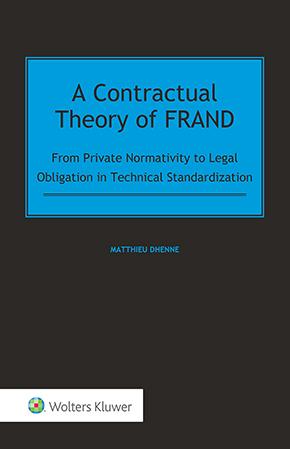
I mentioned earlier this week that Matthieu Dhenne, a frequent contributor to the Kluwer Patent Blog, has published a new book titled A Contractual Theory of FRAND: From Private Normativity to Legal Obligation in Technical Standardization (Wolters Kluwer 2026). I recently finished reading it, and I think it makes an important contribution to the literature. The book begins, and continues throughout, to employ the author’s framework of distinguishing three layers relevant to addressing FRAND questions: the technical standard, the SSO IPR policy, and the individual FRAND undertaking. The technical standard itself creates an “infrastructural dependence” that enables holdup, to which the SSO IPR policy, which may require the FRAND undertaking, is a response; and the nature of that undertaking, in the case of the ETSI IPR policy, is “a French-law unilateral juridical act intended to produce legal effects” (p.4). Put another way, the FRAND undertaking “may be described as a juridical counterweight to” the “leverage created by technical by technical indispensability” (p.20), “an infrastructure-based constraint to principles of legal justification, thereby aligning technical necessity with normative legitimacy” (p.69; see also p.75). More specifically, the FRAND commitment SEP owners make to ETSI creates, as the English courts have recognized, a stipulation pour autrui under French law—effectively, a third-party beneficiary contract, to use common-law terminology—even though the identity of the beneficiaries and the specific content of the FRAND license remain to be determined. From these propositions, Dr. Dhenne concludes that recognizing the FRAND undertaking as contractual in nature is logically prior to such other issues as the availability of injunctive relief, the appropriate royalty rate, and so on; that “the willing-licensee inquiry belongs within the law of performance, good faith, and remedies rather than serving as a complete theory of FRAND” (p.8); that both competition law and patent law should play only a subordinate role in resolving FRAND disputes (see, e.g., pp. 89, 120); and that, “[o]nce a SEP holder has undertaken to license on FRAND terms, an injunction can no longer be treated as automatically available on the same terms as in ordinary patent litigation,” because “the FRAND undertaking conditions its exercise by reference to the undertaking and to the parties’ conduct in performing it” (p.116). To be sure, there are many complexities that a court would need to take into account in crafting the terms of a FRAND license—it’s not just a matter of determining the appropriate rate and base, but other terms and conditions as well—but the author argues that there is nothing unusual about judges having to ascertain the nature of the obligation owing to the third party beneficiaries of a stipulation pour autrui, even if (like the FRAND undertaking) it is not reducible to “a single mathematically acceptable endpoint” (pp. 101-07). The author does not necessarily endorse the English and Chinese practice of establishing global FRAND terms without consent of both parties, however, stating toward the end that “French law governing the ETSI undertaking does not by itself give every court authority to determine a global licence, issue anti-suit relief, or compel arbitration,” because “[j]urisdiction, procedural power, and recognition remain governed by the relevant rules of private international and procedural law” (p.124). He closes with some suggestions for best practices (p.125).
As I stated above, I think this is an important contribution to the literature on FRAND, and I find the emphasis on the ETSI undertaking as a contractual response to restrain technical indispensability as a useful way to approach the matter. Under this approach, both owners and implementers have corresponding rights and responsibilities under French law, the fulfillment of which should lead either to voluntary agreement or, if needed, judicial determination. Shifting the terms of the debate away, to some extent, from competition law and patent law may well be the right perspective; and though there will remain differences among jurisdictions concerning how to determine the appropriate FRAND terms and conditions, the author holds out hope for “convergence around practical guidance shared by courts and standard setters,” similar to what Lord Justice Arnold and Francisco Hernández Fernández have recommended, as this blog has previously noted here and here.

No comments:
Post a Comment